
Short answer: No, it's not too late. Adults in their 50s, 60s, 70s and beyond build real muscle and strength when they train the right way. You may build it a little more slowly than you did at 25, but you start getting stronger within weeks. The bigger risk isn't starting late. It's not starting at all, because muscle loss speeds up the longer you wait.
What happens to muscle as we age
Most of us start losing muscle gradually somewhere in our 30s or 40s, and the loss picks up speed after 60. Doctors call it sarcopenia. You don't notice it at first. Then one day the stairs feel steeper, getting up off the floor takes two tries, or a bag of groceries feels heavier than it should.
Losing muscle isn't just about how you look. Muscle is what keeps you steady on your feet, protects your joints, helps control blood sugar and keeps you independent. That's why we care so much about building it at Results.
What the research actually says
The research here is encouraging, and it's been consistent for more than 30 years:
People in their 90s got stronger. In a well-known study, frail nursing home residents with an average age of 90 trained with heavy resistance for 8 weeks. Their strength nearly tripled, their thigh muscle grew, and they walked faster (Fiatarone et al., 1990). It was a small study, but the message was clear: muscle still responds at any age.
Adults over 50 add real muscle. A review of 49 studies with more than 1,300 adults aged 50 and older found that strength training added about 2.4 pounds of lean muscle in roughly 20 weeks, on average. Programs with more training volume produced bigger gains (Peterson et al., 2011).
The same review found older participants gained a bit less than younger ones. That's not a reason to wait. It's a reason to start now.
So the honest answer: you can absolutely build muscle after 55. It takes consistency, enough challenge, and smart choices about how you load your joints.
The catch: your joints and tendons need to come first
Here's where most people over 55 go wrong. They get motivated, jump into heavy lifting or a high-intensity class, and something flares up: a knee, a shoulder, the lower back. Then they stop for three months and lose what they gained.
The problem usually isn't the muscle. Muscle responds fast. Tendons and joints adapt more slowly, and they need to be built up before they can handle heavy, fast movement.
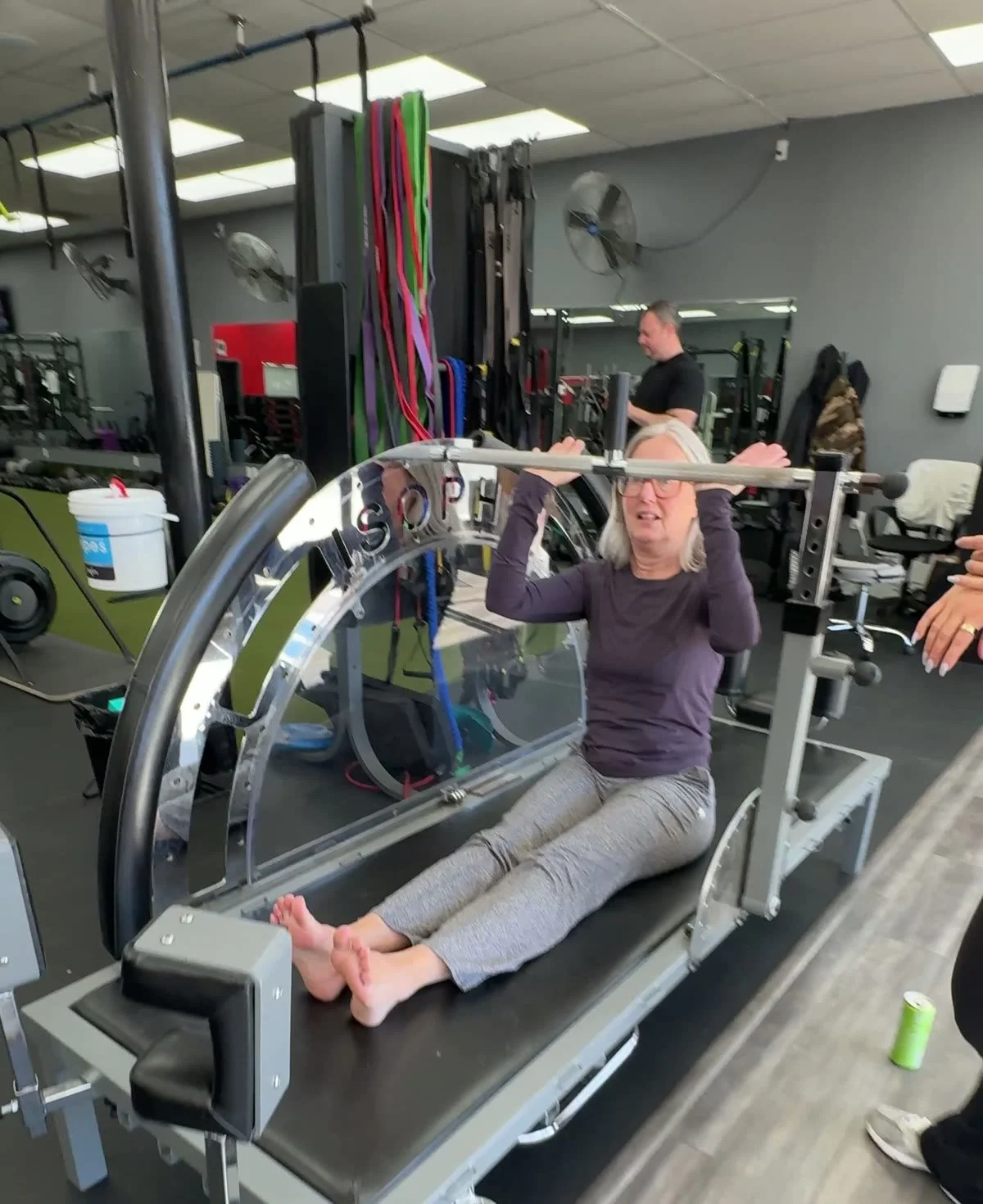
That's why every client at Results starts with ISOPHIT, our Foundation. It's isometric training: you push or pull against a fixed surface and hold a position. Nothing moves, so your joints stay protected, but the effort is real and your muscles and tendons get a strong signal to grow. Your coach sets the angle, so we can work around a sore knee or shoulder instead of through it. (We wrote more about this in ISOPHIT vs. Lifting Weights.)
Once your foundation is solid, and if your goals call for it, we add more dynamic strength work on top.
4 things that matter most after 55
Train with enough challenge. Light, easy exercise feels nice but doesn't build much muscle. The effort has to be hard enough that your body has a reason to adapt. A coach helps you find that line safely.
Be consistent. Two to three sessions a week, every week, beats an intense month followed by a break. Progress at this age comes from stacking months, not days.
Eat enough protein. Older adults need more protein than younger people to build and keep muscle. The guideline we follow comes from the PROT-AGE Study Group, an international panel of geriatric doctors and nutrition researchers organized by the European Geriatric Medicine Society: at least 1.0 to 1.2 grams per kilogram of body weight per day for adults over 65, and at least 1.2 g/kg if you're active (Bauer et al., 2013). For a 160-pound person, that's roughly 75 to 90 grams a day. If you have kidney disease, talk to your doctor first.
Recover. Sleep and rest days are when muscle is actually built. Training hard every day works against you.
How we measure it
"Am I actually building muscle?" is a fair question, and you shouldn't have to guess. Every client at Results gets a 3D body scan every 30 to 45 days that tracks lean mass, body fat and measurements. So instead of relying on the bathroom scale, you see whether you're adding muscle, and so do we. If the numbers stall, we adjust your plan.
Who this is for
Adults 55+ who want to get stronger and stay independent
Anyone who has noticed stairs, getting up off the floor or carrying groceries getting harder
People who tried a gym or class before and got hurt
Golfers, tennis players and skiers who want to keep playing for decades
Our members come from Ridgefield, Redding, Wilton, Danbury and Bethel.
Frequently asked questions
Can you really build muscle after 60?
Yes. Research shows adults in their 60s, 70s and even 90s gain strength and muscle with the right training. Gains may come a little more slowly than when you were younger, but they're real and measurable.
How long does it take to see results after 55?
Most people feel stronger within a few weeks, because your nervous system learns to use the muscle you have. Visible muscle growth usually takes a few months of consistent training. Our 3D scans every 30 to 45 days show you the change.
Is strength training safe if I have arthritis or joint pain?
For most people, yes, and it often helps. Stronger muscles take load off the joints. That's why we start with ISOPHIT, which keeps your joints still while you work hard. If you've had recent surgery or have a medical condition, check with your doctor first and tell your coach.
Do I need to lift heavy weights to build muscle?
Not at first. Hard isometric work builds strength and muscle with your joints protected. Whether and when you add heavier dynamic lifting depends on your goals and how your body responds.
Start with a plan built for your body
The best time to start was 10 years ago. The second-best time is now. Book a free Success Session: we'll scan your body, check your joints and movement, let you try ISOPHIT, and send you home with a plan, whether or not you join.
Book my free Success Session → · Or call or text (203) 438-8771.
Written by Jean-Pierre Mikhael, owner of Results Fitness Ridgefield.